
Built Architecture-First: The Ratals Difference

For years, businesses have been forced into a false choice: wrestle with plugin-heavy legacy platforms, or hand over control - and profit margins - to a locked-down SaaS system that charges for every transaction, seat, and inch of growth.

We built Ratals to make that compromise obsolete. One platform. One cohesive data model. A free, open-source CMS that effortlessly scales into enterprise-grade Commerce and a complete ERP software - without a single migration or re-platform along the way. Everything below isn't a marketing claim we're asking you to trust blindly. It is a set of open benchmarks you can test and source code you can read, so you can see exactly why our numbers look the way they do.

Table of Contents

Why Caching Became a Crutch - and Why It Doesn't Have to Be

To understand why Ratals performs the way it does, it helps to look at how modern software design lost its way.

Most ecommerce platforms running today were engineered when servers relied on spinning mechanical hard drives. Because reading data from a physical disk was sluggish, developers had to force-load everything into expensive, volatile RAM just to keep websites usable. Back then, memory-based caching wasn't a luxury; it was survival. However, that old constraint shaped a whole generation of platforms - and most of them still depend heavily on caching today, long after the underlying hardware limitations have vanished.

Here is the truth the industry rarely discusses: systems that rely on caches to mask a slow backend will always hit a wall. The moment a user logs in, filters a product catalog, or adds an item to their cart, the cache breaks. When that happens, the customer slams directly into the unoptimized backend the cache was meant to hide. This is exactly where transactions drop: memory fills, cache evictions cascade, and performance tanks right as a buyer is checking out. For a shopper, this translates to a page that freezes for seconds while they hold their wallet - and a massive percentage of them simply walk away.

Ratals is built for the hardware running modern data centers today, and not the spinning disks of thirty years ago. Today's NVMe SSD storage reads flat files in single-digit milliseconds. A properly engineered backend doesn't need a heavy memory layer standing between it and the database just to survive baseline traffic. Because of this, our caching system is file-based by design rather than memory-based. Storage is incredibly cheap and stable, whereas RAM has strict physical ceilings. A cached page should never go offline just because a memory threshold was crossed on the server.

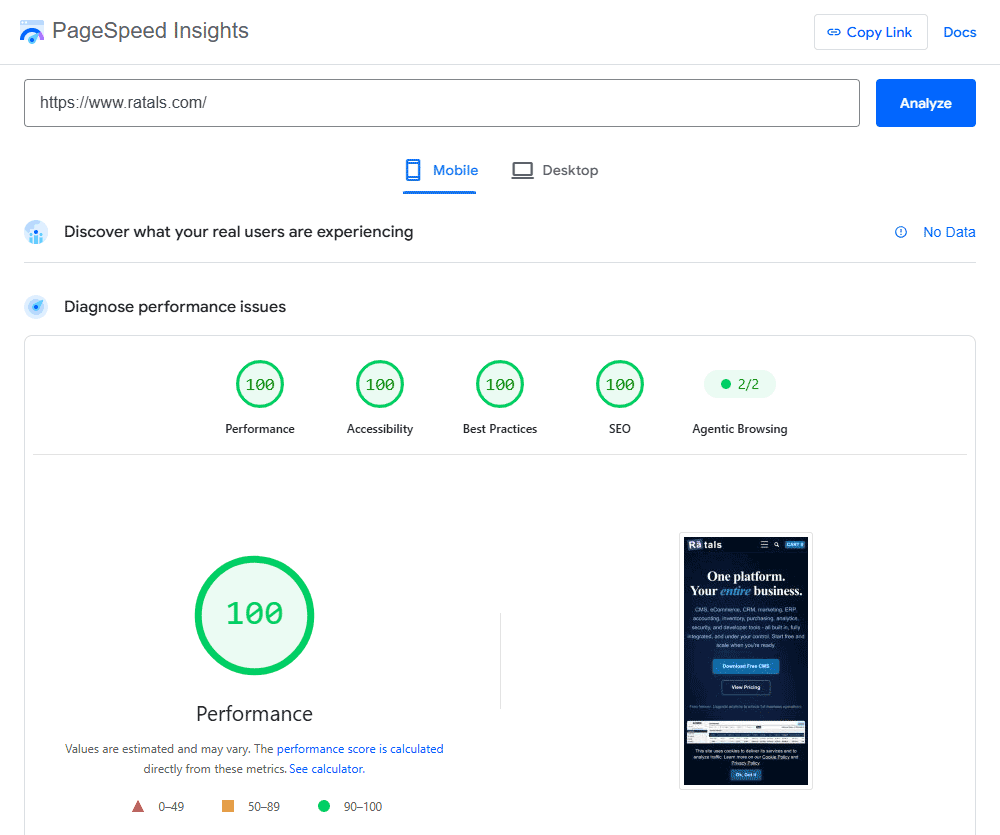
This single architectural shift is why our performance numbers barely change whether caching is active or disabled. With server-side caching turned completely off, the Ratals.com homepage - which loads more than 100 images - delivers a document load time of 246ms, a 0ms Total Blocking Time, and a perfect 0.0 Cumulative Layout Shift (CLS) across both mobile and desktop. Turn caching back on, and document load drops to 88ms while everything else stays flawlessly stable. Simply put: our backend doesn't lean on a cache to pretend it's fast. It is fundamentally fast. Caching in Ratals exists purely to absorb massive traffic spikes at scale, not to prop up a weak structural foundation.

If you would prefer to watch us run these benchmarks live, you can watch our full website speed test demonstration on YouTube. Otherwise, look at these scores as a prime example of the platform in production:

Pagespeed Insights Mobile Perfect Score

Built to Handle Catalogs That Break Other Platforms

An ecommerce platform proves its architectural worth when handling deep catalogs with thousands of products, complex variant matrices, and massive category pages. This architecture matters most at the precise second a customer decides to buy.

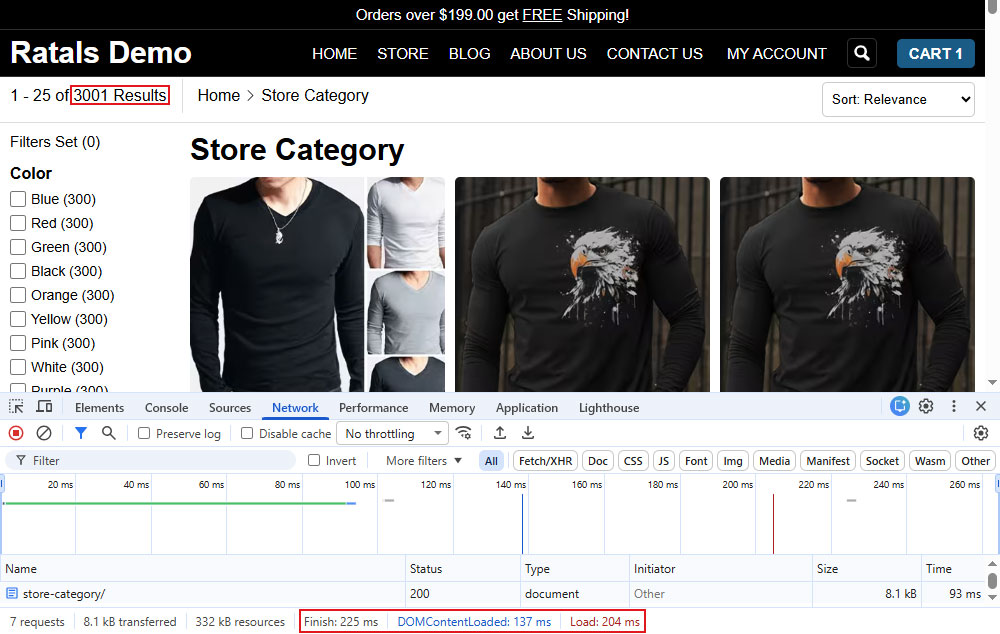
With Ratals, a 3,000-variant product page or a dense category carrying over 3,001 products renders in under 300 milliseconds - with caching completely turned off - on a basic $7-a-month shared hosting plan. Not a dedicated rig. Not an enterprise cloud cluster. And certainly not a hidden memory cache fudging the results behind the scenes. The raw backend handles the heavy lifting natively because scaling without friction was our day-one design goal.

Why does this matter to your bottom line? Slow load times don't just frustrate users; they actively damage search engine rankings and kill conversion rates. Every extra second of latency causes a measurable drop in completed sales. A Ratals storefront isn't just fast under ideal conditions - it stays fast through complex variant grids and deep category hierarchies where competing platforms begin to choke, all on a hosting budget that costs less than a daily lunch.

Take a look at this backend profile as an exact example - a category loading 3,001 inventory items in just 225ms on that cheap shared host:

Category 3000 Inventory Items Super Fast Loading

Every Feature Is Native. There Is No Plugin Tax.

Speed is only half the battle; the other half is what is actually running on that backend. Look at what comes baked directly into Ratals CMS and Ratals Commerce out of the box: complete SEO control over every URL, intelligent internal linking, automated redirect management, active 404 monitoring, a custom form builder, a menu manager, a media slider builder, multi-site network management, and a custom database/admin builder. All of this is included in our free tier.

Step up to Commerce, and you instantly unlock real-time multi-warehouse inventory tracking, carrier-calculated shipping with automated box cubing, secure stored cards via Authorize.net, built-in abandoned cart recovery, native affiliate program management, direct shopping feeds, and first-party analytics. Not a single one of these tools requires a plugin, a third-party dependency, or an extra monthly invoice.

The standard industry alternative involves duct-taping dozens of isolated apps together - one for inventory, another for shipping logic, another for cart recovery, and another for affiliate links. Every single add-on introduces external scripts, security vulnerabilities, and compounding monthly bills. You end up paying a steep tax three times over: in slower page speeds, wider security exposures, and bloated operating costs.

Ratals completely eliminates the plugin tax because there is no patchwork code to begin with. Every feature was engineered by the same core team to work against the exact same flat data schema. Nothing conflicts, and nothing breaks when a system update rolls out. That is what "built-in, not bolted-on" truly means beneath the surface, ensuring your sites and in-house systems don't grow fragile or sluggish as your operation expands.

Starting Simple Doesn't Mean Starting Small

Because Ratals includes enterprise capabilities, it's easy to assume it is only meant for businesses already running massive warehouses. That isn't the case. The free CMS tier is a comprehensive, standalone website builder. You don't need eCommerce modules, ERP functionality, or a massive budget to launch a professional, production-ready site.

Getting up and running doesn't require advanced engineering skills or an intense deployment pipeline. Ratals installs using a straightforward web setup form and a single install button on your server. There are no configuration files to manually edit or databases to wire up by hand; the automated installer handles everything. The result is a clean site that is blisteringly fast from its very first page load, without requiring weeks of fine-tuning.

To show you exactly how it works, we created a step-by-step video installation guide. It covers everything from mapping your domain and configuring hosting to launching your live site. Once you know the steps, you can deploy a live, optimized site in under 10 minutes, knowing you can easily unlock Commerce and ERP features on that exact same installation whenever your business is ready.

The Only Platform With a Real CMS → Commerce → ERP Path

When the time comes to scale past a basic marketing site, Ratals offers a growth trajectory that no other platform on the market can match. You can begin on a free, Apache 2.0-licensed CMS, smoothly transition into Commerce to start taking orders, and eventually expand into a comprehensive ERP for purchasing, accounting, and advanced inventory tracking - all on the identical data model, without ever re-platforming.

This isn't a vague future roadmap promise; it is hardcoded into our core architecture. Ratals Commerce runs on the exact same structural foundation as Ratals ERP. This means vendor records, customer accounts, and order histories established in your storefront carry forward instantly the moment you activate ERP features. Net payment terms map directly to your accounts payable. Shipping fulfillment systems tie straight into your landed cost calculations and inventory valuations. Every transaction automatically transforms into a true accounting journal entry instead of sitting on an isolated data island.

Furthermore, because Ratals is entirely self-hosted with complete source-code access, the platform's economics are a fraction of standard SaaS bills. Our pricing structure is entirely transparent: the CMS is free forever. Commerce is $79/month, unlocking full storefronts, order processing, CRM tools, and marketing suites. The ERP tier is $199/month, adding native inventory control, unlimited warehouse management, purchasing pipelines, and full accounting ledgers. Ratals AI is available at $299/month, layering predictive reporting, anomaly detection, and advanced forecasting across your entire operation. Every tier is billed at a flat monthly price - with zero transaction fees and no per-seat charges, ever. While other platforms punish your success by skimming a percentage of your growing volume, Ratals ensures your software bill stays predictable as you scale.

Every growing business eventually reaches a painful crossroads: choose a lightweight platform and get hit with a costly, disruptive re-platforming project later, or invest in heavy, enterprise-grade software long before they can justify the cost and overhead. Ratals completely removes this dilemma. You scale into our ecosystem on your own timeline, utilizing the same core database from day one and unlocking advanced features only when your business demands them.

Nothing Hidden. Nothing You Can't Verify.

Every technical claim made on this page can be vetted and verified before you commit to anything - and we planned it that way. The Ratals CMS core is fully open source on GitHub under the Apache 2.0 license. You can inspect the codebase, trace our commit history, and evaluate the architectural integrity of the platform before running a single script. We do not believe in black boxes or asking for blind trust.

This transparency drives real engineering accountability. We maintain a clear, public security policy with direct vulnerability reporting channels, document every update via active release logs, and provide a comprehensive contributing guide for developers who want to help guide the core platform forward.

True software control changes your risk profile entirely. Because your site is self-hosted on your own infrastructure, you're never dependent on someone else's uptime, roadmap, or business decisions to keep your own site running. If you ever choose to let a Commerce, ERP, or AI subscription lapse, your CMS and public-facing website stay online. You will never be locked out of your own business data due to a subscription issue, which stands in direct opposition to how traditional SaaS ecosystems operate.

Ratals is built and actively maintained by Rob Cuppett, our founder and lead engineer. We back the platform with an expanding library of video tutorials covering everything from initial installation to deep code customization. If you ever run into a roadblock, an engineering-backed solution is usually already recorded and waiting for you.

This Is What Architecture-First Looks Like

Modern server hardware eliminated the technical excuses for slow backends years ago - most legacy platforms simply never went through the trouble of rebuilding their architecture to leverage it. Ratals did. And outside of sheer website speed, we provide a frictionless growth model that no other platform offers. You can start at zero cost to get your marketing site up and running. As your business gains traction and demands more advanced features, you only pay for what you need, when you need it. You scale your software capabilities alongside your revenue, keeping you completely free from the traditional "all-or-nothing" enterprise pricing trap.

That architectural shift is the engine behind every metric we hit:

  • A 246ms homepage response with caching completely disabled.
  • A 3,001-product category page loading in 225ms on a $7 shared host.
  • A comprehensive feature suite with zero plugin clutter.
  • A live site up and running on your server in under 10 minutes.
  • Fully auditable open-source code you can review before you commit.
  • A seamless path from a free CMS to an enterprise ERP with zero migrations.

This is the direct result of making software architecture the priority rather than an afterthought. Explore the CMS. See Commerce in action. Review our pricing tiers. Watch the deployment guide. Watch our website speed test demonstration on YouTube. Audit the code yourself, or run your own independent speed tests. The metrics stand up to scrutiny every single time, and now you know exactly why.

This site uses cookies to deliver its services and to analyze traffic. Learn more on our Cookie Policy and Privacy Policy.